When our Elders are gone: Cultural Fire, Knowledge, and the Future

Updated: Sep 2

Pima Elder and Native Artist, Marty Meade, speaks to her family about their cultural history.
We have to ask ourselves a difficult question: What happens when our elders are gone-and the knowledge goes with them?
What happens when the remaining cultural fire practitioners are no longer there to teach us when to burn, what plants need fire, what medicines return after fire, and how fire connects to our languages, songs, ceremonies, foods, wildlife, water, and traditions?
For Native Americans, cultural burning has never simply been about reducing vegetation, or preventing wildfire. Cultural burning is about cultivating culture.
It is about keeping our knowledge alive.
It is about keeping our languages alive.
It is about keeping our songs and traditions alive.
It is about keeping our recipes and medicines alive.
It is about caring for the land so that the land can continue caring for us.
And most importantly, it is about carrying that knowledge forward so that our children, grandchildren, and generations beyond us will still understand their responsibilities to the land.
Fire is a Responsilbility
Indigenous communities throughout the world understand that caring for the land is more than environmental management. It is a resonsilbilty handed down throught the generations. Creater gave us responsilbilities to the land, water, fire, wind, plants animals, and culture.
Those responsilbilities did not just cease to continue or disappear because governments drew boundries, agencies assumed jurisdiction, or traditional burning was suppressed, outlawed and carried with it a life sentance. For generations, Native people used carefully timed cultural fire to shape healthy landscapes. Fire encouraged the return of native plants, renewed gathering areas, supported medicines and foods, reduced unhealthy vegetation and maintained landscapes that were both ecologically productive and culturally significant. The objective was never to burn acres. The objective was to care for the land. That distinction matters.

Conventional prescribed fire can be an important tool for reducing hazardous fuels and protecting communities. But cultural fire can have broader objectives. It can be applied with generations of place-based knowledge to restore, regenerate, and rejuvenate landscapes while renewing people's relationships with them.
A succcessful cultural burn therefore can not always be measured simply by the number of acres treated. Sometimes its success appears months later. After the fire moves carefully across the the landscape, dominant, invasive vegetation can be reduced and space created for native plants to return. With winter rains, the land responds. By February or March, flowers may emerge where they have been suppressed for years.
That regeneration is part of what cultural practitioners have understood for generations.
Fire can destroy, but the right fire, placed on the right land, at the right time, for the right reasons, can also create life.
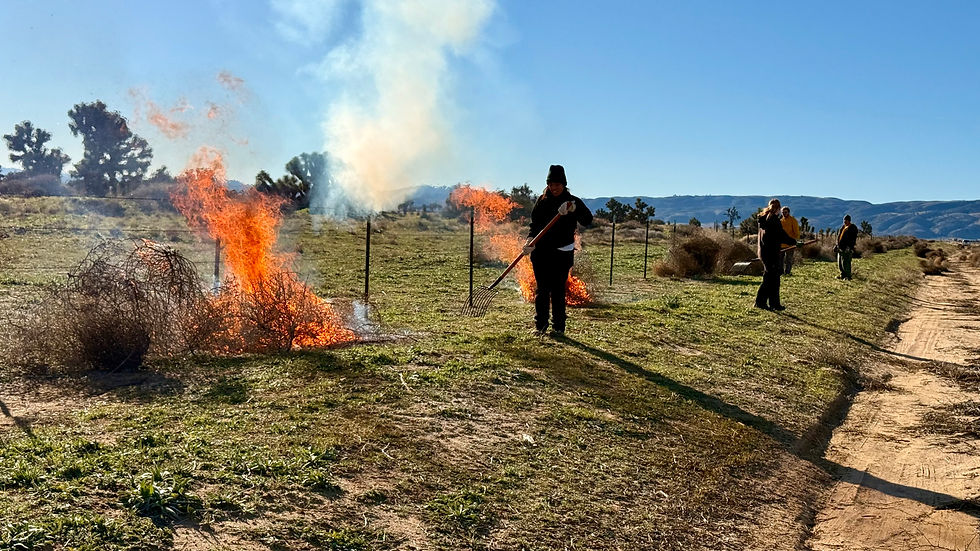
Restoring Fire After Generations of Suppression
In some places, Native American communities are putting cultural fire back onto the lands where it has been absent for generations. That moment represents far more than a precribed burn, it represents the return of knowledge. It represents people saying: We remember how to care for this place.
But restoring cultural fire also means rebuilding the human infrastructure necessary to carry it forward. That ia why training is so important.
We must prepare new fire practioners, burn bosses, community leaders, Native youth and cultural knowledge keepers, who can return to their own communities and become leaders themselves.
The goal cannot be to create permanent dependence upon a small number of cultural experts. The goal must be to grow the next generation of leaders.
We should be able to look across California and eventually across the country and see people who were once students now leading burns in their own communities, teaching their own youth and passing that knowledge forward. That is how cultural knowledge survives.


Partnership and the Barriers to Cultural Burning
Today, many cultural burns take place through partnerships with private landowners, nonprofits, prescribed burn associations, fire agencies, land conservancies,
local governments, and public land managers. Those partnerships can be extremely valuable.
There are also legitimate safety conciderations surrounding fire. Burning must account for weather, fuels, smoke, wind shifts, surrounding communities, available personnel, and the posibility of runaway fire. No responsible cultural burn fire practitioner wants fire placed on the land when conditions create a clear and present danger of catastrophic wildfire. But there is also a difficult intersection between the two systems and that creates an important question: How do we protect public safety while also creating a pathway for Native communities to exercise meaningful cultural fire sovereignty?
Partnership should not mean replacing Indigenous knowledge with agency knowledge. It should mean bringing knowledge systems together while respecting the people whose ancestors cared for the land for thousands of years.

The long-term vision must be greater Native tribal leadership, capacity and authority so that cultural fire is not merely something Native communities are occasionally able to demonstrate. Rather, it becomes something Native communities are empowered to practice, teach, and carry forward.
The Urgency of Knowledge Transfer
This work carries extraordinary urgency because our greatest libraries are not buildings.
They are our Elders.
When an elder passes without the opportunity to transfer their knowledge, we can lose information and cultural history accumulated over countless generations--knowledge about plants, seasons, fire, water, wildlife, foods, medicines, ceremony, language, and relationships with particular landscapes.
Some knowledge cannot simply be reconstructed from a textbook. It must be experienced.
A young person needs to stand beside an elder and hear why a particular plant matters. See the plant, feel and smell the soil, and feel a protectiveness over that plant so they come to understand that the plant has cultural significance and it represents life--our continued life, our continued ways.
They need to understand why one landscape is burned in one season and another at a different time. They need to see how vegetation responds.
They need to smell the smoke, watch the wind, understand the moisture in the soil and observe what returns months after the fire.
Eventually that young person becomes the practioner.
Then the practioner becomes the teacher.
And someday the teacher becomes the Elder.
That is how knowledge survives.

Our history is not in library buildings...it is in our elders, and when they are gone our history goes with them.
Many of the educational institutions that stand today were once purposely built to take our children from us--to remove them from their families, their communities, their languages, and their cultures, and assimilate them into Western non-Native society. These intitutions attempted to erase the pieces of identity that made us who were are.
When we learn the history of fire removal, we begin to understand that was deeply connected to the removal of the Native American people from their homelands. The people were removed and the fire was removed with them.


We were not supposed to be here today. We were not supposed to survive. But here we are.
Many of us may not know this part of our history because that history was deliberately fragmented through colonization, forced assimilation displacement, and industrilization. What we are doing today is picking up the pieces that our ancestors and relatives left for us and using them to rebuild the future we want to see. Inter-tribal relations allow us to share our knowledge and fill in the missing gaps of our lost traditional ways and practices.
Each of us has a place. Each of us has a role. We are learning the lessons of our homelands again, understanding our place within the cultural cycles that sustained our lands for generations.
It has taken generations of colonization, hurt, trauma, and removal for many of us to find our way back--to our culture, to our homelands, and to FIRE. But returning to fire also means returning to the responsibilities that come with it.
California would not be the landscape it is today without generations of Native people using fire to care for it. For many years the goal was to advance the Native people and Native America's Indian Country. But now that responsibility is becoming even greater. I am talking about Indigenous people all over the world. I am talking about the planet.
What can we do to help save the planet? How do we save Native lands and the communities that surround them? How can we bring people together to care for the land? Because the more we work together, the stronger we become.
I dream of a day when our children and grandchildren will not have to work so hard to "reconnect." They will not have to search for the pieces of themselves that were taken away. They will not have to find their way back--because they will already know the way.
And perhaps that is one of the greatest responsibilities we carry today: to make sure the path home is never lost again.


DEDICATION:
This piece is dedicated to my Aunt Marty. My inspiration, my Elder, my beautiful thread of connection to the knowledge of my people in the tapestry of who I am--of my story.
Thank you Auntie for allowing this once small girl to touch your braided hair, watch you cook in the kitchen, forever implanting the smells into my deep memory. Thank you for teaching me the ways of our people, the lost knowledge and inspiring me to look for the knowledge that belongs to me. With me, my generation, I break the cycle. The cycle of Indian shame and self-harm. I wear the blanket of our trauma and shame no more. Instead I put my feet on the land and my hands in the soil and give thanks to the Creator for this beautiful and abundant world. I feel the wind through my hair, the sun on my face and continue to exsist proudly. I will continue to regain our culture and preserve our knowledge, to carry it forward into the future generations-- so that they are never disconnected, pushed out, or ever feel that they aren't "Indian enough to have knowledge." Thank you Aunt Marty for lighting the sacred fire within me so that it will always lead me home.
I love you, Jennifer

Comments